Category Archives: Walk With Christ

Five Ways to Memorize Scripture (August)

aug14 2 By Allison 

[This is the second article in a series that we will be posting this month, focusing on the importance of Scripture memory.]

“Bible memorization is absolutely fundamental to spiritual formation. If I had to choose between all the disciplines of the spiritual life, I would choose Bible memorization, because it is a fundamental way of filling our minds with what it needs. This book of the law shall not depart out of your mouth. That’s where you need it! How does it get in your mouth? Memorization.”*

Memorization is definitely an important discipline, but how do we memorize? When we think of memorization, what usually comes to mind is what we call rote memorization, which is just repeating a verse over and over until it is stuck in your brain.

There are several disadvantages to this method, including the fact that it is not very effective, nor very fun. Contrary to popular belief, memorization can actually be fun, especially using some of the methods that I will outline for you here. There are a few basic things you need to know for any memorization, no matter what method you choose to use. First of all, you need to pray. We should pray before completing any activity, but especially memorization because of its difficulty. It is only by the Holy Spirit’s power that memorization is possible for any of us. aug2014

Before you begin memorizing, make sure you have a plan. I find that if I do not outline some goals for what I hope to accomplish, and include due dates, it usually does not happen. Maybe your goal could be to memorize the book of Ephesians in a month. Then you would want to break down that goal into smaller more manageable parts like five verses a day, or something like that. As the saying goes, “Failing to plan is planning to fail.”

I find that without a proper understanding of what I am trying to memorize, I will never get it. Even before I begin to memorize a passage, I will study it. It is helpful for me to print out the verse/passage on a piece of paper and read it over several times, noting what it says and the key words. Then I go through it and highlight key words with symbols. This helps me to understand what the verse is about. It is also important to note the context of the passage, who said it, when they said it, where they said it, why they said it, and how they said it.

Now to the fun part, the actual memorization.

  1. One of my favorite methods of memorization is to draw pictures for each word, or phrase to help them stick in my memory. A word picture, or rebus, is very simple to make, it just take a little creativity. For example, in John 3:16 you could use the number four to represent the word for. For God, you could use a picture of God. For so, you could use a picture of someone sewing, and for love, you could use a heart. You get the idea. Once you have the whole verse in pictures (the little words like “an” and “in” you can just write), read the verse out loud from that card several times, then try to picture the illustrations in your head as you recite it from memory.
  2. Another method that’s a lot of fun (and good exercise) is to put hand and body motions to the words. The more you get your whole body active in this memorization process, the easier it will be to memorize. To illustrate, Psalm 119:11 would go something like this: “Thy [point up toward heaven] word [hold hands like an open book] have I [point to self] hid [cup your hands as if you had something hidden in them] in mine heart [form a heart with your hands and place it where your heart is in your body], that I [point to self] might not [do the sign for “no”] sin [slap your hand] against thee [point to heaven]. Do the hand motions several times while looking at the verse, and then see if you can repeat it from memory. Make sure you really have it solidified in your head before you move on.
  3. A fun way to memorize while doing chores or other tasks is by listening to the verses you are memorizing. There are several ways to do this. You can record yourself reading the verse, and then listen to that recording whenever you would normally listen to music. You can also listen to an audio Bible (many are available on the internet for free).
  4. Even more effective than that is listening to the verse put into song. Many musicians have put verses to song, if you can get your hands on some of their music. One great online resources is freebiblemusic(dot)com, which offers many verses put to song for free. If you can find no songs for the passage you are memorizing, make something up. You can use a favorite tune, or make up your own. As long as it sticks in your head, it does not matter how bad the tune sounds.
  5. During your memorization sessions, try reading the verse out-loud emphasizing different words. To illustrate, Deuteronomy 11:18a says, “Therefore shall ye lay up these my words in your heart.” You could say, “Therefore shall ye lay up these my words in your heart,” and then, “Therefore shall ye lay up these my words in your heart,” etc. When combining this with some of the other methods I have mentioned, you will have the verse down in no time.

Remember to persevere. You will most certainly face trials from the devil who does not wish you to memorize, because he knows how beneficial it will be to your life. Memorization takes a lot of diligence, a lot of repetition, and a lot of prayer. Include all of these things daily to your memorization life.

Memorization takes a lot of diligence, a lot of repetition, and a lot of prayer.

How are you doing? What is the Lord teaching you about memorization? How has memorization benefited you? What are your favorite methods of memorization? I would love to hear from you! I plan to include your stories in my fourth article, so if you would like to share, email me at theindwellingwordministries[at]gmail[dot]com. I look forward to hearing what God is doing in your life through the memorization of His Word!

~Ashley (15)
{Guest Writer}


*Dallas Willard, in Vocatio

DEADLINE SOON for our Writing Contest…

And…our Photography Contest:

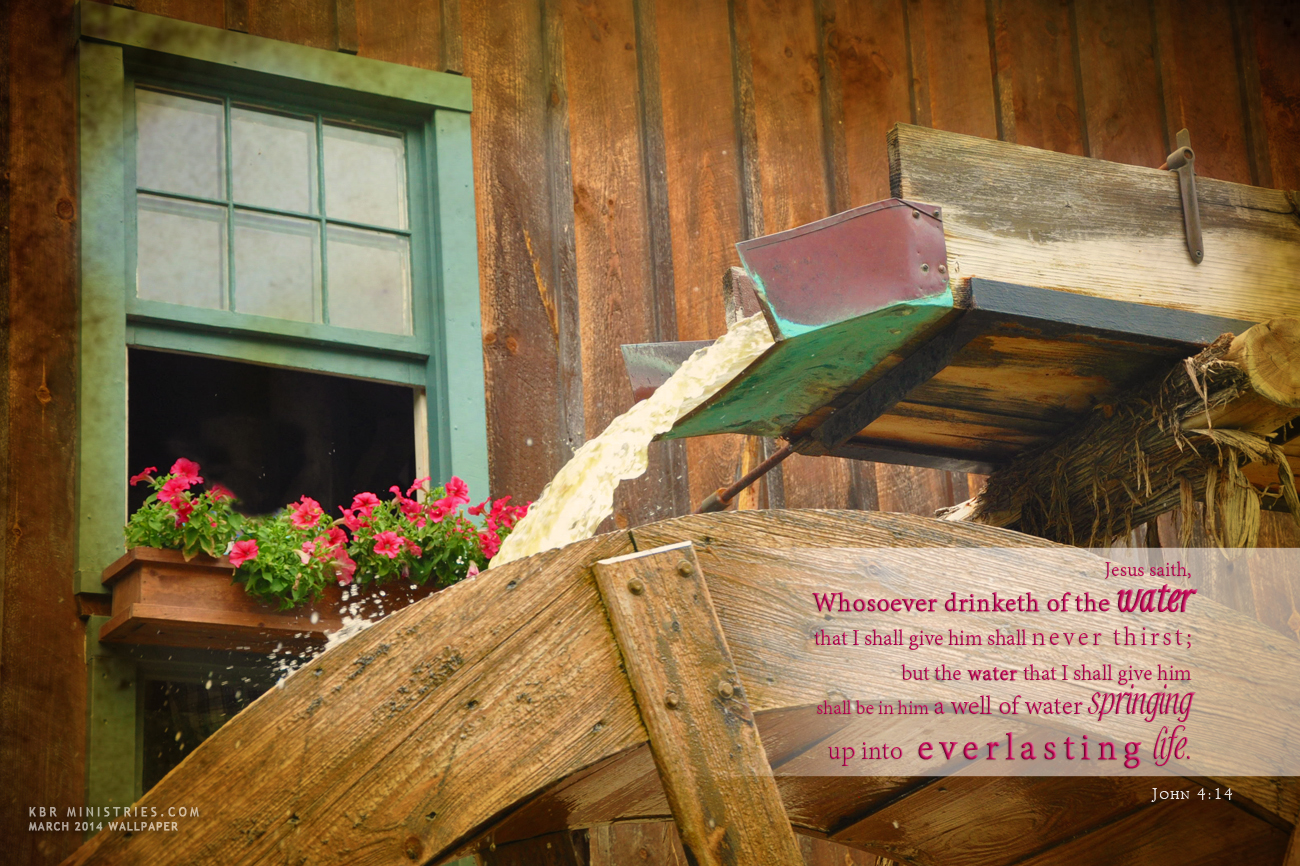
This Month’s Desktop Wallpaper  

Why Memorize Scripture? (August)

aug20142

By Allison 

[This is the first article in a series that we will be posting this month, focusing on the importance of Scripture memory.]

“’Let the word of Christ dwell in you richly…’” “’Let the word of Christ dwell in you…’ Oh, what was that last word! Hmm, richly? Yes, I think that’s it. ‘Let the word of Christ dwell in you richly.’” In this manner, Rebekah poured over her Bible as she memorized the third chapter of Colossians.

Why did she do this? Why go through hour after hour of hiding God’s Word in our heart? I believe that the Bible offers clear answers to these questions.

1. We are commanded to memorize Scripture

The first and most important reason that we should memorize Scripture is because God’s Word commands it. You may have come across one or two passages in your Bible reading, but did you know that Christ exhorts us in this way over 17 times? If He is this serious about memorization, we should be too.

One of the lessor known verses concerning memorization is Deuteronomy 32:46, which says, “And he said unto them, Set your hearts unto all the words which I testify among you this day, which ye shall command your children to observe to do, all the words of this law.” Notice the command, which charges us to set God’s teachings upon our hearts. This verse comes from Moses at his last speech to the people of Israel before his death. Then look at what he says next: “For it is not a vain thing for you; because it is your life: and through this thing ye shall prolong your days in the land, whither ye go over Jordan to possess it” (Deuteronomy 32:47). Memorizing God’s Word is not by any stretch of the imagination time wasted. It is our life! It prolongs our days both physically and spiritually.

2. It helps us guard against sin and the devil

Psalms 119:11 speaks such truth, leaving no doubt about the importance of God’s Word to us: “Thy word have I hid in mine heart, that I might not sin against thee.” Why did David memorize Scripture? To help keep himself from sin. We must do the same.

Faith is our shield and the Word of God is our sword, according to Ephesians 6. How do we attain faith? Through the Word of God (Romans 10:17). So then, both our defense and our offense comes from the Word of God. I have seen personally in my life how the devil flees from the strength and power God’s Word. Often, if I am awakened in the middle of the night by a bad dream, I will quote Scripture, and fear will vanish and the peace of Christ overflows me.

Similarly, when I am tempted to walk past my sister struggling to lift a box of toys, the Holy Spirit reminds me of a verse that encourages me to put the needs and desires of others before my own (Philippians 2:3) and help her. In this way, the Sword keeps me from sin.

If we are not constantly filling our minds with the truth, the lies of the world and the enemy will overpower us. Memorization places the truth in our minds every minute of the day.

aug2014

3. It helps us share with unbelievers

What better tool to use in sharing the Gospel than the Gospel itself? The following verses show the importance of using God’s Word when witnessing.

“So shall my word be that goeth forth out of my mouth: it shall not return unto me void, but it shall accomplish that which I please, and it shall prosper in the thing whereto I sent it.” –Isaiah 55:11

“So then faith cometh by hearing, and hearing by the word of God.” –Romans 10:17

“And that from a child thou hast known the holy scriptures, which are able to make thee wise unto salvation through faith which is in Christ Jesus.” -2 Timothy 3:15

“The law of the Lord is perfect, converting the soul: the testimony of the Lord is sure, making wise the simple.” –Psalm 19:7

God’s Word is the power that converts the soul, that does not return void, and that makes us wise for salvation. As 1 Peter 3:15 exhorts, we must prepare ourselves for witnessing conversations by hiding God’s Word in our heart, because our mere words are not sufficient. Only the living and powerful Word of God is “quick, and powerful, and sharper than any two edged sword, piercing even to the dividing asunder of soul and spirit, and of the joints and marrow, and is a discerner of the thoughts and intents of the heart” (Hebrews 4:12). Let us wield this sword of truth as warriors in the kingdom of God.

aug20143

4. It gives us a deeper knowledge of and love for God’s Word

Ten times in Psalm 119 David talks about how he delights in God’s Word. A diligent study and memorization of God’s Word has prompted this. He has seen the words of the Lord and encountered the benefits that they bring, and will not let them go now.

As we spend time studying and memorizing God’s Word, we will grow to love it more. It has been said that we crave what we consume. If you are always eating junk food, the healthy things that are actually good for your body may seem flavorless. On the other hand, as you wean yourself of the sugarcoated food, the nourishing things like salad taste better and better. It is the same with His Word. The more you consume it by reading, studying, and memorizing, the more you will begin to see its value and long for more and more. Just try it!

There are countless more reasons for memorizing God’s Word. I challenge you to begin the memorization journey yourself and experience these benefits firsthand. I would love to hear your discoveries and share your testimony in a future article. Email me at theindwellingwordministries @ gmail . com. I can’t wait to hear what God is doing in your life through the memorization of His Word!

In next week’s article, we’ll share some tips on how to memorize Scripture.

~Ashley (15)
{Guest Writer}

You’re Invited to Participate in our Writing Contest…

And…our Photography Contest!


This Month’s Desktop Wallpaper

Sitting at His Feet & Serving with Joy (July)

July2014By Rachel Crosswhite

Martha quickly kneaded her bread dough and formed it into a perfect loaf shape. This meal had to be just right, because a good friend of hers was there in the small village of Bethany visiting Martha and her sister, Mary. The friend was in the next room, and it was Jesus! Mary and Martha had looked forward to this day for some time, for they dearly loved Jesus.

As she shoved the loaf into the oven, Martha grumbled to herself: “Why am I the one doing all this work for our meal? Mary should be helping, but there she sits with Jesus!” Martha hurriedly began working on the other food, thinking similar thoughts. Once or twice she stopped a moment to peek into the next room, hoping to see her sister getting up to join her in the preparations. But each time Mary was always in the same place – listening with close attention to Jesus’ words.

Finally, a sweaty, frustrated, and irritated Martha, her arms akimbo, marched into the room where Jesus and Mary sat. She asked in an exasperated voice: “Lord, do you not care that my sister has left me alone to serve? Tell her then to come help me.”

Jesus gently rebuked her. “Martha, Martha! You are worried and troubled about many things. But one thing is needed, and Mary has chosen that good part, which will not be taken away from her.”

Martha felt so ashamed. “I’m sorry,” she murmured, taking a seat on a stool by Jesus’ feet. “I got so caught up in other things that I forgot how I should be taking time to listen to you instead.”

Jesus smiled, and this time, spoke to both of his friends. Martha listened attentively, and her heart was filled with happiness. She knew that this time she was making the right decision: sitting at the Master’s feet, and being spiritually fed. The meal she was preparing could wait. For now, she was feasting on food that would satisfy her soul.

[Based off of Luke 10:38-42]

July20142


As we learn from this story of Martha, we should not allow the cares of this world, as important as they may be, to take from our time with the Master. Time with Jesus – should be one of the most important things we do each day.


“Seek ye first the kingdom of God, and his righteousness;
and all these things shall be added unto you.”
(Matthew 6:33)

The Holy Scripture tells us, I love them that love me: and those that seek me early shall find me. (Prov. 8:17) We should desire to be with our Master, to be more like Him.

Mary, for instance, was sitting at Jesus’ feet, listening very carefully to all he was telling her. She took the time to quietly listen, to meditate, to seek Him.

Glory ye in his holy name:
let the heart of them rejoice that seek the LORD.
 Seek the LORD and his strength, seek his face continually.” 
(1 Chronicles 16:11)

Mary had peace in her heart – her heart rejoiced – because she sought the Lord.

What Martha was doing was not wrong – there is nothing at all wrong with doing household chores, or of eating or sleeping. Those things are necessary things! The point is…what comes first when the Lord is speaking? Shall we live without thinking about the Lord, (except on Sundays), or live in the Spirit and abide in the Lord’s presence every day of the week? Dishes and food and beds can wait – remember, they are not eternal. Let us begin living our eternal life now by sitting at the Lord’s feet, listening to Him, today. Let us choose the better part that can never be taken from us.
My prayer is that I will always have time for my Master, and not let anything else be more important than Him – I don’t want to be like Martha, who was so busy, that she forgot how Jesus was most important.

Make me to understand the way of thy precepts:
so shall I talk of thy wondrous works.”

(Psalm 119:27)

~Rachel Crosswhite {Guest Writer}

This Month’s Desktop Wallpaper
kbrwallpaper_jul14

The Power of the Tongue, Part 2 (March)

Part 2 (read part 1 here)
by Sarah L. Bryant

Every word of God is pure:
he is a shield unto them that put their trust in him.”
(Proverbs 30:5)

Last month, we looked at the power and influence of our words—they hold the power of life and death. What an encouragement this is to seek out how our Lord would have us to speak honorably. Proverbs 25:11 says that “A word fitly spoken is like apples of gold in pictures of silver.” The blessing that our words can bring to others is incredible. Have you ever received a kind word on a day when you were discouraged—and been blessed? We all have been given the ability to uplift and exhort one another with our tongue.

“The words of a man’s mouth are as deep waters,
and the wellspring of wisdom as a flowing brook.”
(Proverbs 18:4)

What a beautiful and peaceful picture is given here—the words of the wise are overflowing with wisdom, as a deep flowing brook. We remember from Proverbs 31 that the words of the wise woman are filled with wisdom and kindness. Isn’t the mental picture of a prudent Christian woman beautified, when we consider that her words spill forth with wisdom—not folly and idleness? James 3 says that “The wisdom that is from above is first pure, then peaceable, gentle, and easy to be intreated, full of mercy and good fruits, without partiality, and without hypocrisy. And the fruit of righteousness is sown in peace of them that make peace.” Wisdom is shown/proven through good conduct and wise, meek conversation. Our words need to reflect that which is pure, peaceable, gentle, merciful, without partiality—and without hypocrisy.

“The words of a wise man’s mouth are gracious.”
(Ecclesiastes 10:12)

Our words should not only be wise and purposeful, but also overflowing with grace…refined and gentle. Foul words, idle phrases or crude exclamations, flippant remarks, and degrading judgements should not be found on the lips of a wise woman. Some phrases and exclamations that are commonly heard in our culture are so easy to pick up, and before long, they become a habit. I encourage you to stop and think carefully about the phrases you commonly use. Are they gracious? Seek the Lord humbly, and ask Him to set a watch over your mouth. Ask for His grace in your life, to guard your lips before ungracious words come forth. The fool speaks before he thinks, and later regrets. Therefore, a wise woman must be one of few words. “In the multitude of words there wanteth not sin: but he that refraineth his lips is wise” (Proverbs 10:19). We must ask that the Lord would purify our mouths and help us use self-control in what comes forth.

Ephesians 5:1-4 contains some powerful exhortations on this topic. Let us break it down as we read…

“Be ye therefore followers of God, as dear children;”

Are we saved by God’s grace? Are we His own precious, adopted children? Then let us take careful note of what follows—

“And walk in love, as Christ also hath loved us,
and hath given himself for us an offering and a sacrifice to God
for a sweetsmelling savour.”

We are commanded to walk in pure love, because Christ Himself walked in love, giving Himself for the redemption of our souls. We know this truth to be life-changing…

“But fornication, and all uncleanness, or covetousness,
let it not be once named among you, as becometh saints;”

Now, we might feel justified as we read—“Okay, I don’t usually have a problem with that list…”

“Neither filthiness, nor foolish talking, nor jesting,
which are not convenient: but rather giving of thanks.”

Wait—we need to stop and examine ourselves here! Fornication is very wicked, a sin that we tend to think we would never fall into. However, foolish talking and jesting? Now that something we all do at some point or another. Foolish talking in this passage refers to silliness, ridiculous talk, nonsense, useless/idle words, or “buffoonery.” Certainly, this is not a category that I want to fall under—but do I?

And what exactly is jesting? It is joking, teasing, making puns, or being “witty” just to gain attention. Wow! I find myself convicted by this very potent passage—a lot to evaluate in my own life. We find here in God’s Word that foolish or silly talking and teasing is not to be our regular practice and habit as Christians. There are possibly appropriate times for joking with those we love, but we need to guard against this becoming a regular occurrence, since it can so easily become a habit. It is easy to constantly tease our siblings to the point that we cannot have a sober, edifying conversation with them, to joke with our friends because we are uncomfortable with getting around to serious subjects, and constantly make idle remarks just so that others think we are funny.

This passage gives us a needed reminder to steer against light-heartedness, joking, and foolishness. This is a very heavy topic to consider and pray about, for I am sure most of us struggle with this at some point or another.

“Speak not evil one of another, brethren.
He that speaketh evil of his brother, and judgeth his brother, speaketh evil of the law,
and judgeth the law: but if thou judge the law,
thou art not a doer of the law, but a judge.”

(James 4:11)

Once again, we are shown in God’s Word that our words carry so much power. Speaking evil of one another, slandering one another, speaking unkind words—all of these things are using the power of the tongue to bring death, rather than life. It can be easy to let our guard down around our family, who we are around the most. We can let unkind words fall on those we love the most, sometimes speaking evilly against our family members behind their back. This should never be our practice as God’s children. We need to carefully guard against this, for the consequences can be far-reaching, beyond our imaginations.

“My tongue shall speak of thy righteousness 
and of thy praise all the day long.”
(Psalm 35:28)

Here is one of the positive ways we can use our tongue—God’s praise! God is richly glorified when we open our lips in praise and adoration of His infinite goodness and mercy. His praise should be on our tongue all the day long. It should spill forth in every conversation and lighten our countenance. Our Lord desires and is magnified by our humble praise. He has done so much for us—loaded us with daily and hourly benefits (Psalm 103:1-5). How can we but speak His praises? This is one way we can open our mouth and give forth life!

“A good man out of the good treasure of the heart bringeth forth good things:
and an evil man out of the evil treasure bringeth forth evil things.

 But I say unto you, That every idle word that men shall speak,
they shall give account thereof in the day of judgment. 

For by thy words thou shalt be justified,
and by thy words thou shalt be condemned.”

(Matthew 12:35-37)

Here, our Lord Jesus gets to the heart of the matter. What comes forth from our lips is what is in our heart. Sister, if your heart has not been regenerated—cleansed and redeemed by the blood of Jesus Christ—you abide under judgement and will find no power within yourself to conquer the tongue (Romans 3:23). You must repent of your wickedness before a holy God, and beg forgiveness under the atonement of the Lord Jesus (Romans 5:8). He is ready and able to forgive, and wipe your heart clean (Ezekial 36:26). Jesus alone can cleanse your mouth and set forth His praise forevermore thereon (Romans 10:9-10)!

As I have studied God’s Word on this topic, I have felt the Lord’s conviction. I have seen areas that need to be changed. At first, I thought that it would be very difficult to discipline myself to be purposeful about my words, but as I sought the Lord in prayer to assist me in this goal, I found victory in Him. He enables that which He commands.

Sister, please stop and consider the words of your mouth. What category would most of your words fall under—wise, gracious, kind, foolish, idle…? This is no light matter before our holy and gracious Lord. We will be called to give account of every word (Matthew 12:37)! If you find that your words need to speak more life and your vocabulary needs refinement, please ask the Lord to purify your mouth! It is definitely not unattainable; the Lord’s grace is more than sufficient. He blesses our efforts to be obedient to His commands.

We have been saved by the precious blood of a Savior, Whose Words spoke this world into being (Hebrews 1:1), Whose every word was pure and loving. Who, by being the very Word (John 1:1-3), has shown us the way of redemption. He has given us the privilege to speak words as well. We can choose to embrace the power of the tongue to be a blessing on a daily—hourly—basis, if we refrain our lips from guile. “For he that will love life, and see good days, let him refrain his tongue from evil, and his lips that they speak no guile.” (I Peter 3:10)

I don’t know about you, but I want my heavenly Father to be the doorkeeper of my lips!
Will you pray with me—

“Set a watch, O LORD, before my mouth;
keep the door of my lips.”
(Psalm 141:3)

At His mercy,

P.S. There are countless other verses God has given us about the power of our words, and I encourage you to personally study this topic and seek the Lord as you evaluate your own life.
 

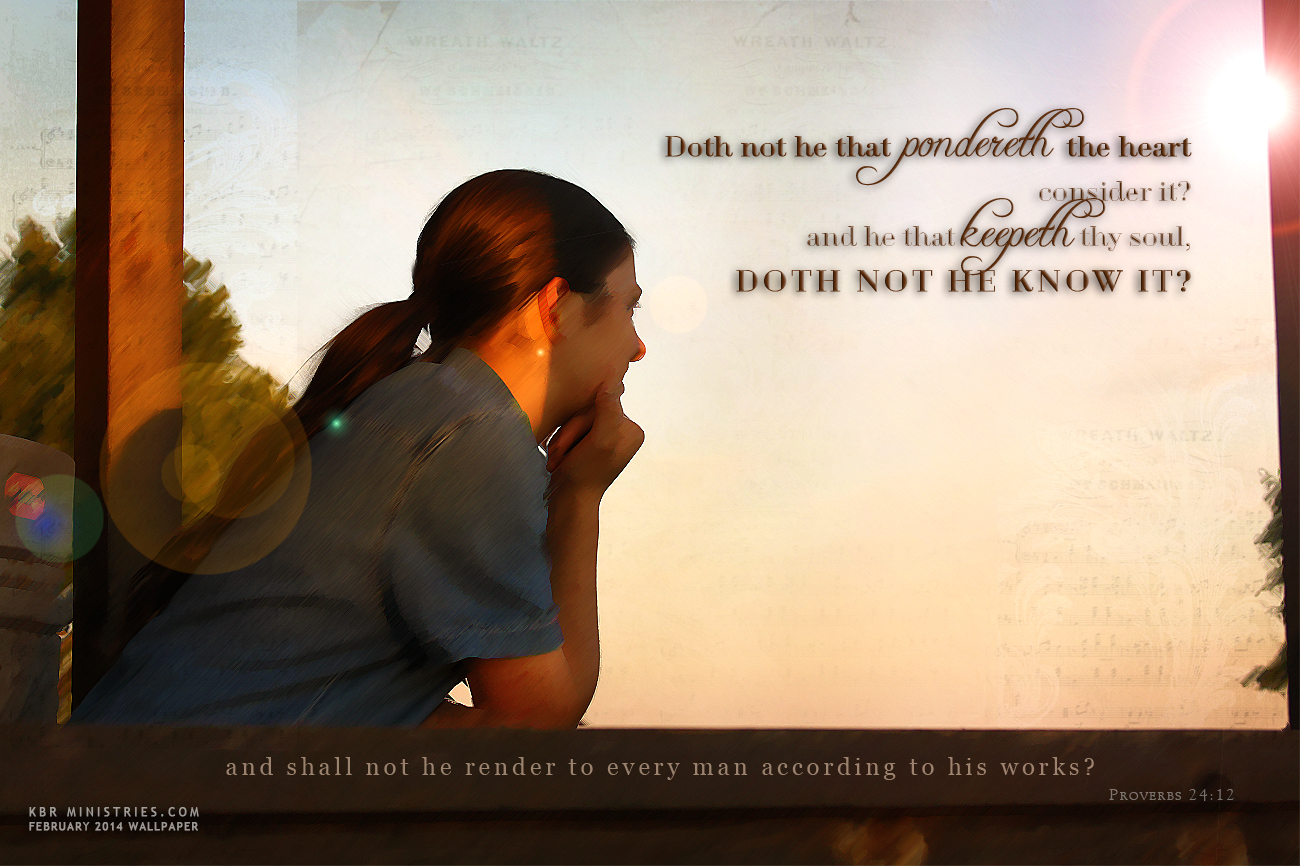
Monthly Desktop Wallpaper

The Power of the Tongue (February)

Part 1
by Sarah L. Bryant


“Death and life are in the power of the tongue:
and they that love it shall eat the fruit thereof.”
(Proverbs 18:21)

God’s Word has been speaking to me about the influence and importance of my words. As I have noted the countless verses that speak directly of the power of the tongue, I have learned that this area is not something to be taken lightly, for it is obviously extremely important to the Lord. Our words will reap tremendous blessed fruit or painful consequences. In fact, this verse says that death and life are in the power of our tongues. That is pretty amazing to think about. To be sure, our actions are very weighty; yet, our words can bring even more powerful consequences! God’s Word states that “the tongue is a little member, and boasteth great things. Behold, how great a matter a little fire kindleth!” (James 3:5) This passage also says that the tongue is an incredibly difficult, and even impossible, member of our bodies to tame—outside of the power of the Lord in our life.

As we study this topic and see how important our words are, it is helpful to consider the example of our perfect heavenly Father. What are His words like? Psalm 12:6 says, “The words of the LORD are pure words: as silver tried in a furnace of earth, purified seven times.” Never does ANY word or even letter come forth from the Lord’s mouth without being completely refined and perfected. In fact, they are like silver purified seven times in the hottest furnace. After seven purifications, silver is completely pure and of highest quality. Similarly, God’s words are utterly perfect and we can trust our lives upon the truth of His promises.

The Psalmist revels, “How sweet are thy words unto my taste! yea, sweeter than honey to my mouth!” (119:103) How beautiful and joyful are the words of the Lord to us, as His children!

As I consider how quickly I can slip and say something unkind or ungracious, I stand in awe of my God, Whose every word is PURE. How humbling it is to see my own frailty and weakness, in governing one of the smallest instruments of my body—my tongue! And yet, how comforting it is to know that the Lord’s strength is ever present, if I will humbly ask Him to set a watch over my mouth, and help me speak in a way that always honors Him.

Psalm 139:4 reminds us of how important it is that we carefully chose our words, for every single one is heard in the very throne-room of God: “For there is not a word in my tongue, but, lo, O LORD, thou knowest it altogether.” This thought is extremely sobering! It reveals how imperative it is for us to know HOW the Lord wants us to govern our tongues. It encourages us to check our words and evaluate them in light of our holy Redeemer’s standard.

So, what does the Lord say about this topic? What does “taming the tongue” look like? How thankful I am for the dozens of verses that the Lord has given in His Word, which focus on this topic. I would like to share several helpful passages with you.

“The words of the pure are pleasant words.”
(Proverbs 15:26)

On a most basic level, our words should be pleasant—pleasing, uplifting, edifying, a blessing for others to hear. We do not want to be like the brawling woman described in Proverbs, whose lips constantly complain and nag, and whose mouth is like a dripping faucet. As sisters, we should strive against nagging our siblings or bossing them around constantly. It is helpful for me to challenge myself to “pleasant words” as an exercise (it is not always easy!).

“A soft tongue breaketh the bone.”
(Proverbs 25:15)

Truly, a kind and gracious word in the face of anger or opposition breaks the conscience. Picture this scene: you have been cooking in the kitchen, and your older sister walks in the room and notes the large mess that has been made. Needing to make dinner, she impatiently comments, “Why did you make such a mess? I need the kitchen cleaned up so that I can prepare dinner!” Your natural tendency, of course, would be to reply impatiently at her remark. However, what if you decide to respond with a soft word—in love and kindness—rather than impulsive impatience? You kindly reply, “I am so sorry this project took me so long. I am finishing it up right now and will wash the dishes in just a minute so you can make dinner.” Can you see how this response would convict your older sister and soften her impatience, and allow you both to work together the rest of the evening without conflict and bitterness? Soft words of kindness can truly mend relationships within seconds—it only requires swallowing that pride!

“Therewith bless we God, even the Father;
and therewith curse we men, which are made after the similitude of God.
Out of the same mouth proceedeth blessing and cursing.
My brethren, these things ought not so to be.
Doth a fountain send forth at the same place sweet water and bitter?”
(James 3:9-11) 

I have been pondering the sad fact that from our mouths often come blessing and cursing, as this passage points out. Isn’t it true, that at church, we can speak words of kind encouragement to someone, and the next hour at home, we can snap at a sibling? How can this be so, if the sweet water of Jesus Christ’s spirit truly flows in our heart (John 15:4)? How can we spill forth “sweet” water, and “bitter” water? It ought not to be this way! Our family members should never be treated with less honor and love that others outside of our homes. Let us seek to be true real and honest before the Lord, for He knows our hearts—and our words.

There are several more passages that I would love to share with you, dear sisters, on this topic, and I hope to do so in next month’s article. Meanwhile, this month, will you prayerfully study James chapter three, learn about the power of your words? You will be amazed at how much emphasis He places on the power of our tongues. Then humbly evaluate your words and pray for wisdom as to how to open your mouth with wisdom and love. Ask the Lord to convict you of areas that need to be changed. May this be your heart’s prayer:

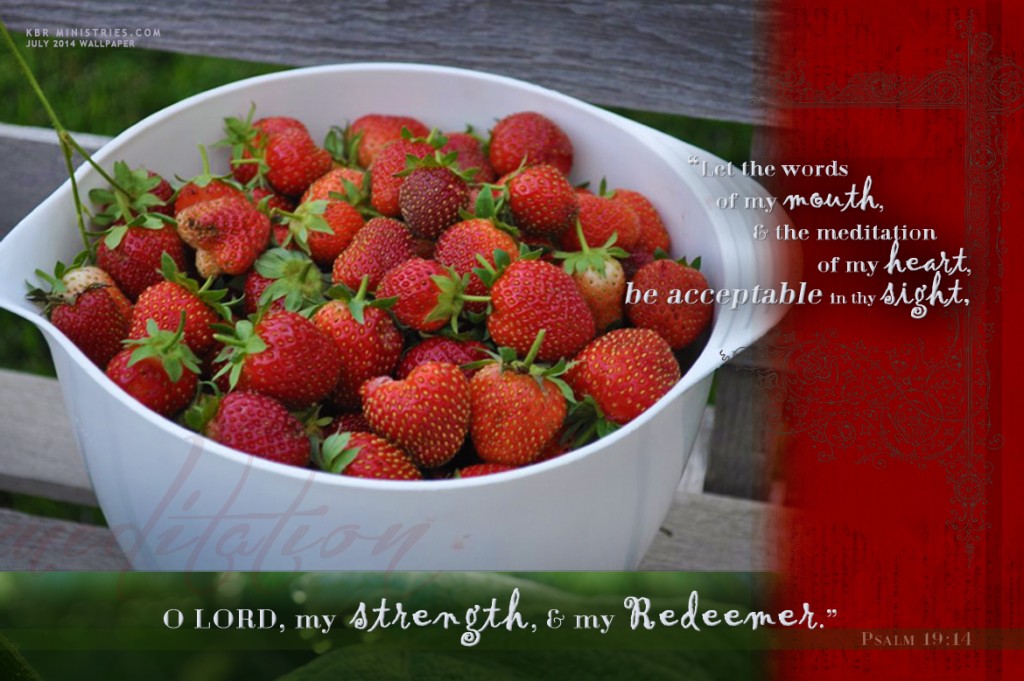
“Let the words of my mouth, and the meditation of my heart, 
be acceptable in thy sight, O LORD, my strength, and my redeemer.” 
(Psalm 19:14) 

“A man hath joy by the answer of his mouth:
and a word spoken in due season, how good is it!”
(Proverbs 15:23) 

Let us seek to speak words of LIFE!

Rejoicing in the WORD,

P.S. Be sure to check back this month for a special surprise we will be sharing on our website!

Monthly Desktop Wallpaper